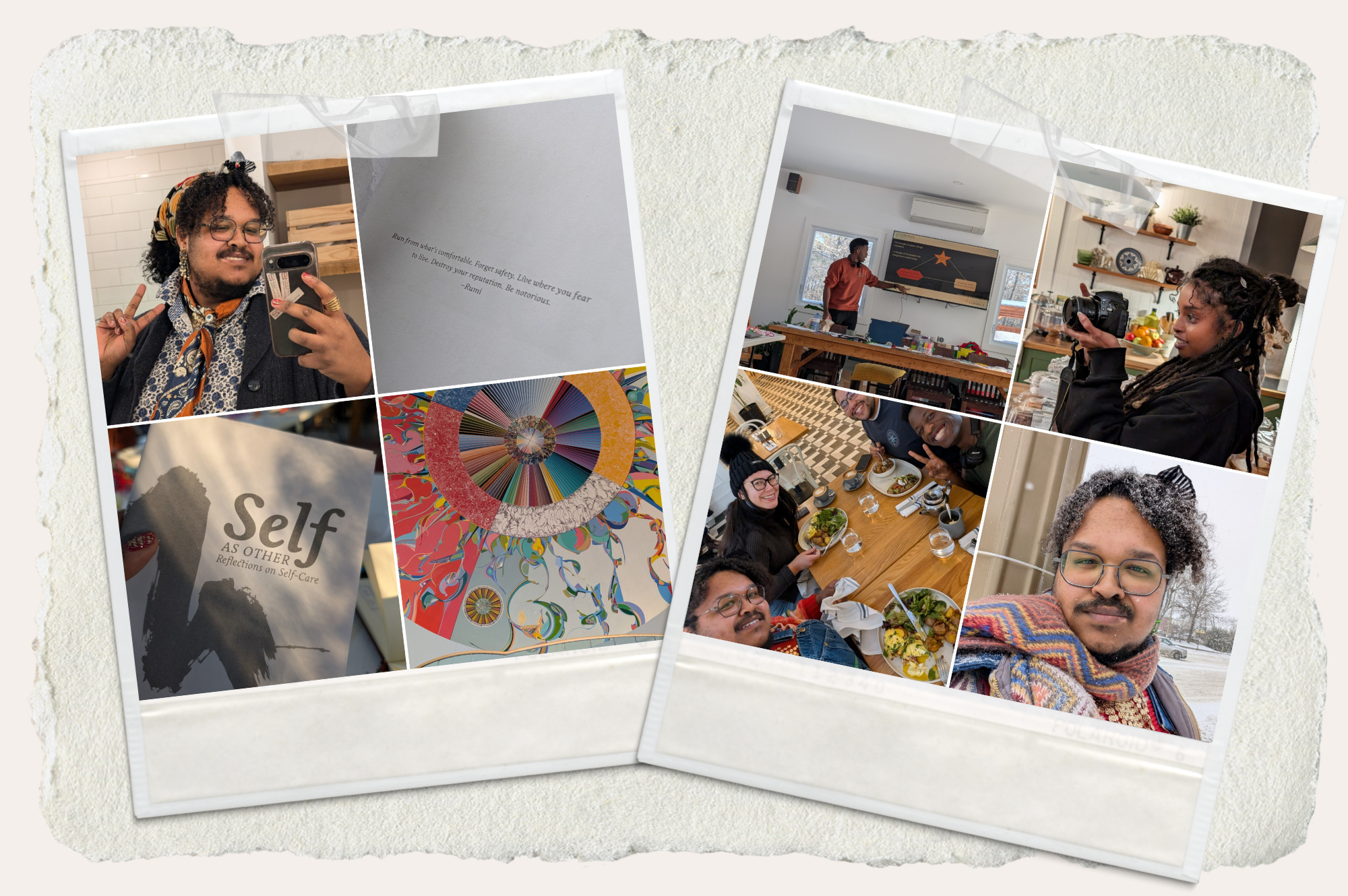
I spent my spare moments writing a poem a few weeks ago: after meals, during zine-making, between presentations, at last month’s Collaborative Community Builders Youth Retreat in Gatineau. As an introduction to Righting Relations, over a dozen youth from across Canada connected for an in-person weekend for peer-led education and relationship building.
And I think the poem captures my reflections, mostly. If you can’t tell, (no shade, because you don’t have to read it at the link here) it was highly rewarding. Specifically, it did a few things.
First, I gained valuable knowledge and connections with folks across the country (Halifax, Montreal, Toronto, Hamilton, Winnipeg, Regina, Calgary, Edmonton, and even rural Alberta near BC and the NWT border). Secondly, it broadened those oh-so-important horizons as an artist, activist, and cultural worker. Third(ly?), it helped me strengthen my own craft/work here in Saskatchewan, because I learned so much from those peer-led education sessions.
For example, do know how to engage your community while building a community garden? Or start up a peer-led non-profit? Or make zines? Or develop your storytelling skills for use in activism? Or engage with the United Nations to make change? Or understand the triangle of system change evaluation?
I didn’t either. But now I’m well on my way!
Of course, I also offered my own presentation. Any guesses? Well, as a surprise to nobody, I offered a five-minute micro examination on effective engagement with the media. Which brings us to the point of this whole blog post.
Most folks are scared to engage with the media. Reporters can be cold, scary, or misconstrue your words. They might be biased, we think. Or have an agenda. Or maybe they just always ignore you and you’re tired of screaming into the void and never hearing so much as boo from them. Well. Unfortunately, all of this can be true in some instances. Most of the time not. But sometimes, yes.
But I’ve been there. So, today, I’m going to re-unpack five tips for artists and activists to remember when engaging with the media, which is essential in raising the profile of your event, protest, or your art.
It’s not as scary as you think!
1: Pitch a full-fledged story.
My busiest day as a reporter (back in the good ole days) probably included four interviews, and three events. Obviously, the day was slightly blurry, but I prided myself on never missing a meeting over those years I worked as a staff reporter and then editor.
As such, it’s important to remember that reporters are busy. And as the industry generally continues to constrict, it’s not an issue that’ll be alleviated anytime soon. So, when you’re wanting to get media coverage for your protest, or book launch, or non-profit fundraiser, you must not bury the lede.
- What is the real heart of this story?
- Why does it matter?
- Who cares?
- Why now?
- When did this happen/will happen?
- Where is it happening?
- How is this event happening?
Make sure most, if not all these questions, are covered off in your pitch email. Even better, if you can answer “What is a new angle they haven’t reported on before?” and offer your story as an answer to that problem, you’re off to the races.
2: Get to know your media.
Well, Miguel. How do we know what angles the media has already reported on?
And to this inevitable question, I say “do you research.” Some media has a strong conservative bias, some media will only run super-super-super local stories, some will want to publish nuanced features, others will want shorter, sweeter, TikTok-ready stories.
So, you need to get to know your media. Read their stories. Sign up for their newsletter. Get to know them. Even better, try and wrangle a reporter into meeting for coffee, and letting them put a face to a name. And then build that relationship—send them cool news that fits their beat, remember their name, thank them for their work. Suck up, a little (they will know if it’s insincere).
P.S., don’t forget to send the right stories to the right folks. Often, you won’t know which reporters cover which stories. Small town papers will have one reporter, but when you’re looking at those provincial news organizations, they rarely break it down by beat. In this case, if you’ve done your research, you can read all the art stories and see which name keeps cropping up. That’s probably your arts reporter.
But, if you’re lucky, there will be a list of contacts you can choose from! Choose wisely.
3: Make it easy. Suuuuuper easy.
Now, before you send your super-sick story to your targeted reporter, take pause. Have you made it as easy as possible?
As I mentioned above, reporters are busy. Even reporters I know can take days to respond to emails, because the news cycle doesn’t rest. If something crazy happens (Queen Elizabeth II died around the time of my book launch for my first novel), you’ll get pushed down the docket. But the easier you make your story, the more likely they’ll run it.
- Easier, for a reporter, looks like a great press release: sample here.
- Easier, for a reporter, looks like a press kit with photos they can publish and links to more in-depth information.
- Easier, for a reporter, looks like plain language and industry-specific language defined.
- Easier, for a reporter, looks like an additional document with common terms explained with deeper context.
These four items are incredibly important for activists, artists, and non-profit organizations especially, who are known for having a lot of in-depth specialized knowledge or language. Especially when we’re talking artists statements or political manifestos. In activism, we talk about systems of power. The media is one of those systems. So, we must be cautious and clear, even overly explaining things that shouldn’t necessarily require it. Better to be safer than sorry.
The easier, the better.
4: Align with industry standards.
I mentioned a press release before, which, in theory, is a finished article they can simply run with little to no editing. That’s not normally the case. There’s many a free press release template, but no one ever discusses what’s supposed to be in the press release.
Now that you know your story, the reporter you’re targeting, and you’ve made it easy, I want you to write a news article. Since you’ve done your research, you’ll know there’s never an exclamation mark. There’s very little hyperbole. There are always a few nice quotes from someone important within your group, organization, etc.
So, write it up.
Check it for errors. Check it again. Make sure the date is correct, write up a title you think you’d see in your media of choice. Then, when it’s all finished, and you’ve made it as clear and easy as possible, pause.
Media in Canada often (really, always) align their writing with Canadian Press Style. There’s a long history there, but essentially it exists to standardize media writing across the country, whether in Iqaluit or Vancouver, Regina or St. John’s. You can find some information out there, but if you’re going to be engaging with the media, it might be handy to find a copy of the style guide here. If not through this site, next time you’re thrifting, take a peek. You never know!
5: Give grace, but be a little dogged
You’ve finally hit send. And you’re expecting to hear back in 48 seconds from an excited reporter, ready to tell your story. But you don’t. You wait, and wait, and wait, and wait, and wait, and wait. A day passes. Maybe another. And you think it’s a lost cause.
Well, reporters are getting emails. Sometimes hundreds of emails, per day, per week, per month. It’s likely that either it was lost in the inbox, something more pressing came up, or they’re not interested.
With that in mind, it doesn’t hurt to email and follow up. Once. Maybe twice. Or three times even. And if they really aren’t interested, don’t take it personally. Reporters often compartmentalize their work, because there’s so much. It’s a passion for them, of course. But it’s also work.
If you follow these five tips as closely as you can, there’s no promises in life, but you should be getting some nibbles. Every story isn’t everyone’s cup of tea, unless you’ve won the Nobel Prize (congratulations). So don’t sweat it.
And these tips don’t even cover everything off. So much work goes into media engagement. I don’t think I’ve even scratched the surface of what I’m thinking about when working on a press release, but it’s a start.
Go and engage with that media, folks!
– – – – –
Miguel Fenrich (he/him) is a queer, black artist living on Treaty 6 Territory in Saskatoon. As a truthteller, he explores community/culture/care through an anti-racist lense, and is the author of Blue: a Novel and What Lies in the Valley. He is the 43rd President of the Saskatchewan Writers’ Guild. You can find him on Instagram, and reach him at miguelfenrich@gmail.com